
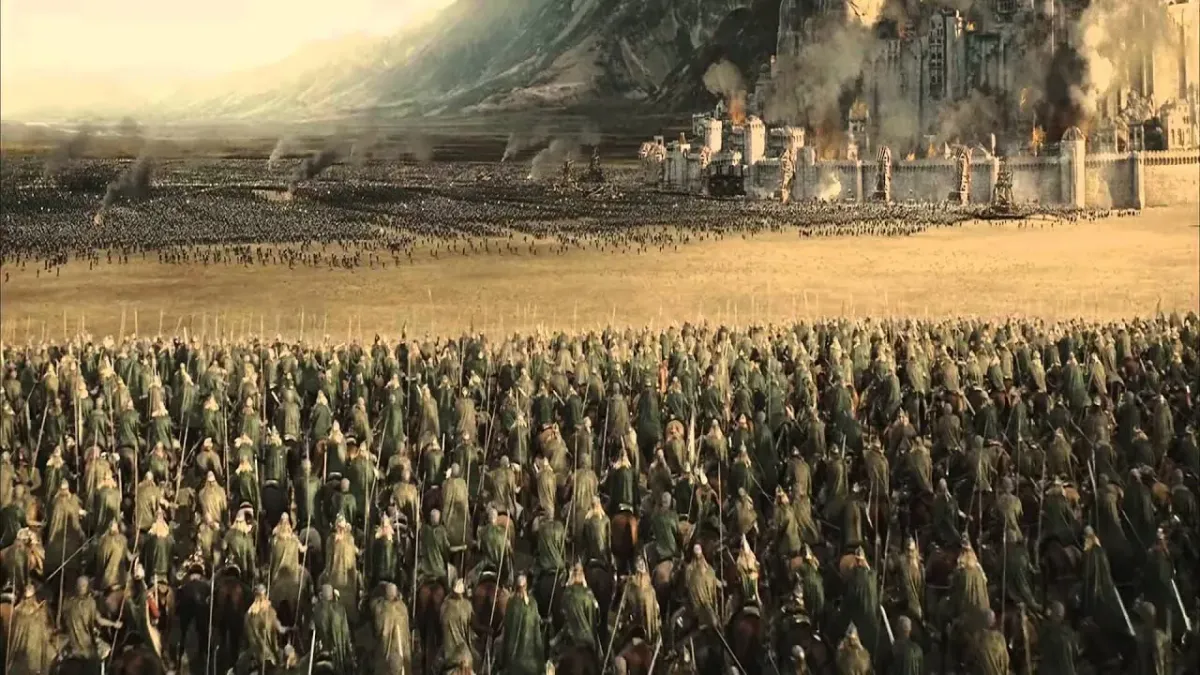
There’s something about a cavalry charge that just gets the blood pumping.
It’s tempting to chalk it up to a modern fascination with an antiquated way of war, but they were waxing poetic about equestrian combat in the 1800s. People galloping toward certain danger and, perhaps, winning the day simply because they have the cajones to ride a horse full-speed at a freaking army is an undefeated premise.
It’s like driving a car 80 mph into a brick wall while not wearing a seatbelt. There’s only two possible outcomes: death, or heroically smashing through the wall.
In a trilogy full of powerful moments, the charge of the Rohirrim at the Battle of the Pelennor Fields has always stood near the very top. When all hope seems lost, the Rohirrim take the field and keep evil at bay, not with magic or fabled weapons but simply through reckless courage. It’s awe-inspiring. And a reminder to keep fighting even if the odds don’t appear to be in your favor. Deep down, bad guys and bullies are cowards; they run at the first sign of serious resistance.
I decided to break down this sequence, partly to discover its secrets, but more to marinate in its wonders.
For science, I compared the theatrical and extended editions of the charge. The extended edition is only 6 seconds longer (4:02 vs 4:08). Even watching them back-to-back, nothing jumped out as obviously different. The extended cut probably just has more random horse porn. That both editions are nearly identical seems an acknowledgement of the scene’s flawless nature. Peter Jackson couldn’t cut anything.
The theatrical edition commits one of its most egregious sins here, cutting away during the charge’s climax to inform us Denethor has gone mad—like we needed that reminder—before returning for the final 16 seconds. The extended cut gives us the full monty, all at once, and we’re better for it.
Here’s the full scene, from the extended edition, for your reference and enjoyment.
All timestamps are from the extended edition.
Minas Tirith in flames
The gates have been breached. The Gondorians fall back behind successive defenses, but it’s only a holding action. The battle is lost. Hide your kids, hide your wife, and hide your husband ‘cause they raping everybody out here.
High in the city, Gandalf the White faces the Witch-king of Angmar. It’s no contest. Gandalf’s staff is shattered by sorcery and he’s thrown from his horse. You’ve never seen a more visceral example of impotence. HIMS should use it in their next commercial.
2:32:10: The Witch-king raises his sword for the killing blow. A war horn interrupts.
He immediately flies off. It’s almost like he recognizes that horn. Like he knows the orcs are in deep shit.
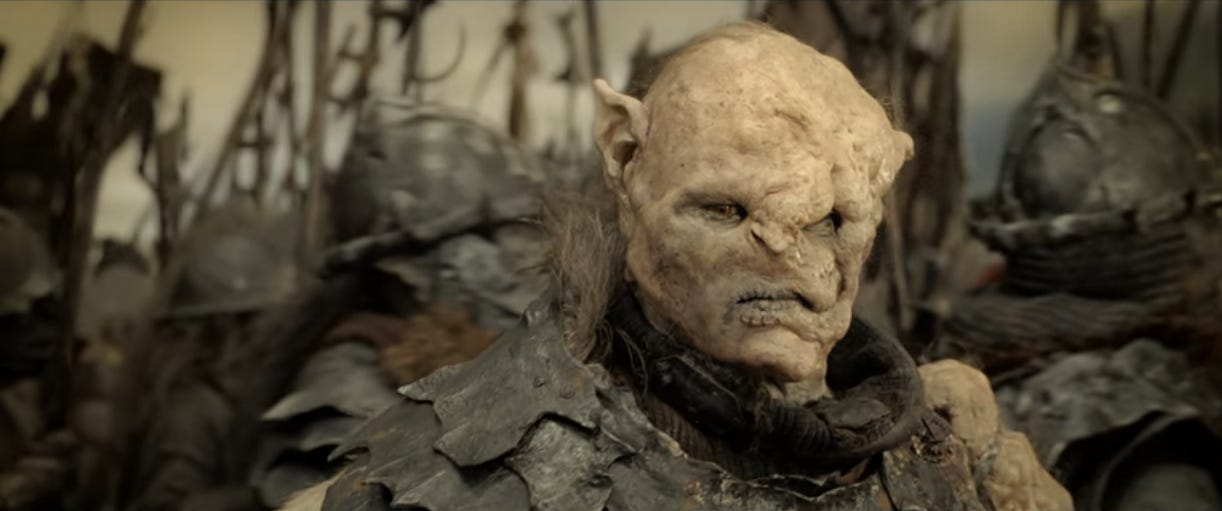
2:32:23: Incredibly, melted potato-face is the only orc who notices the blaring war horns.
The bar for advancement in Sauron’s army must be very low. Just have some situational awareness.
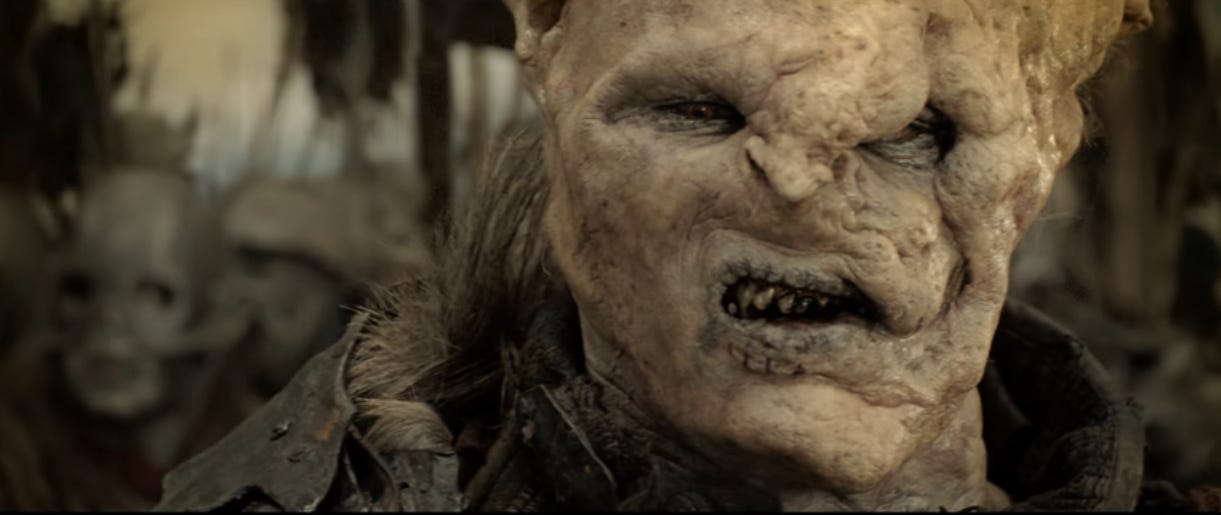
2:32:26: Potato-face steps toward the camera, giving us a closer look at his ugly mug. He resembles the cannibalistic offspring of five generations of albino orc incest.
The other orcs have finally turned toward the sound. They’ve clearly been trained to respond whenever Potato-face abruptly stops and wanders a few feet away.
The Rohirrim haven’t even appeared yet and we’ve already gotten two notable enemies to react.
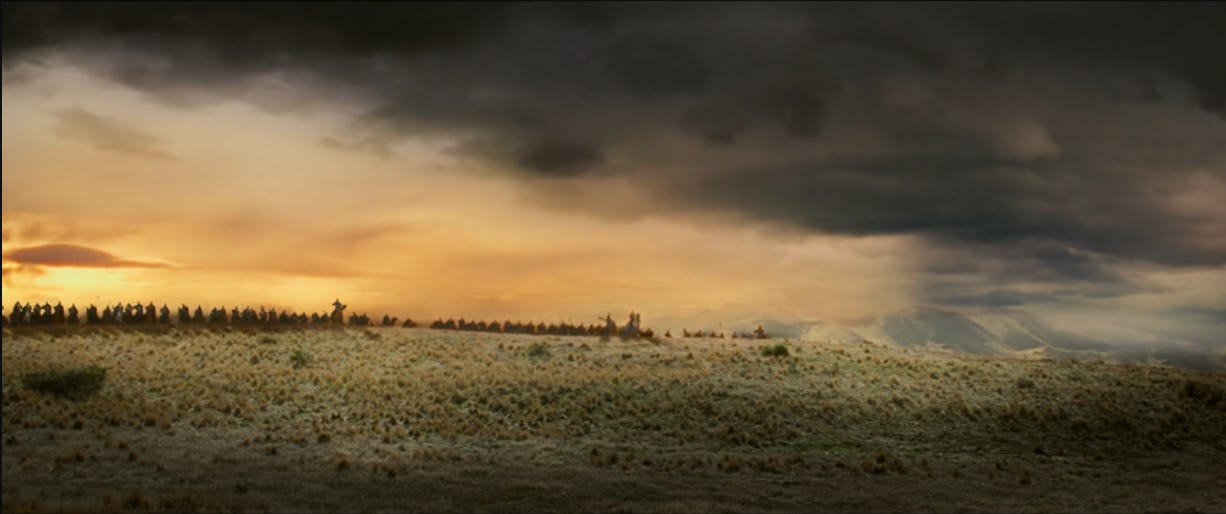
2:32:28: With the light literally and metaphorically going down in the west, the Rohirrim crest a distant hill.
Is this convenient timing or a new strategy? At this point in the trilogy, they’re undefeated attacking an overwhelming force with the sun at their back. Imagine King Théoden on the other side of the hill, waiting for the perfect moment to appear. Even if it grants no strategic advantage, points for style.
A totally pedantic detail, but this is the timestamp I’m using for the start of the charge because it’s when the Rohirrim appear.
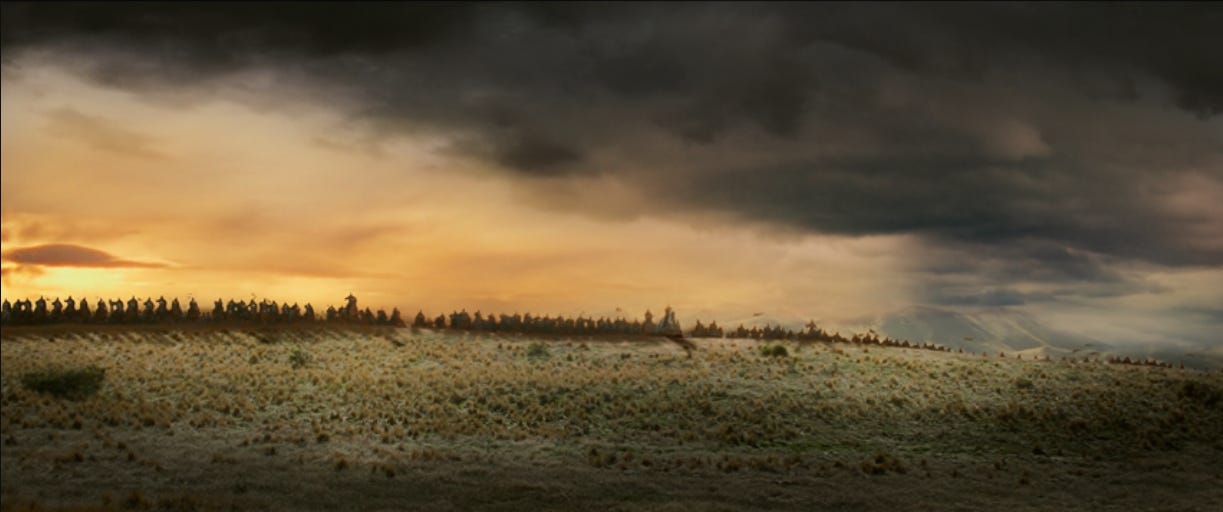
2:32:34: Still cresting.
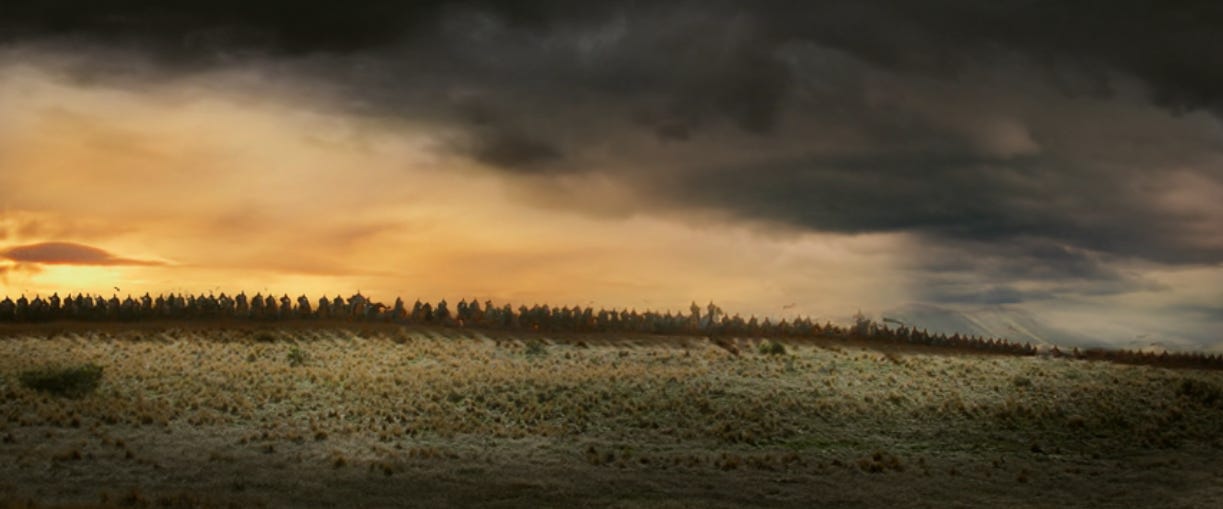
2:32:40: STILL CRESTING.
12 seconds of horsemen emerging from behind a hill. That’s a very long time to show something that should be boring. Taylor Sheridan employs more horses than anyone working in Hollywood. He doesn’t do anything as patient, instead opting for quick cuts backed by country-rock. Different demo, sure, but at the end of the day it’s dudes riding horses. One is majestic, the other meh.
I tend to roll my eyes when cinephiles bemoan how streamers have eroded film as an art form, but when I look at this shot, they have a point. Often epic fantasy means dragons and elf-lords and, yes, titanic battles. But part of what makes this scene so incredible is how it builds.
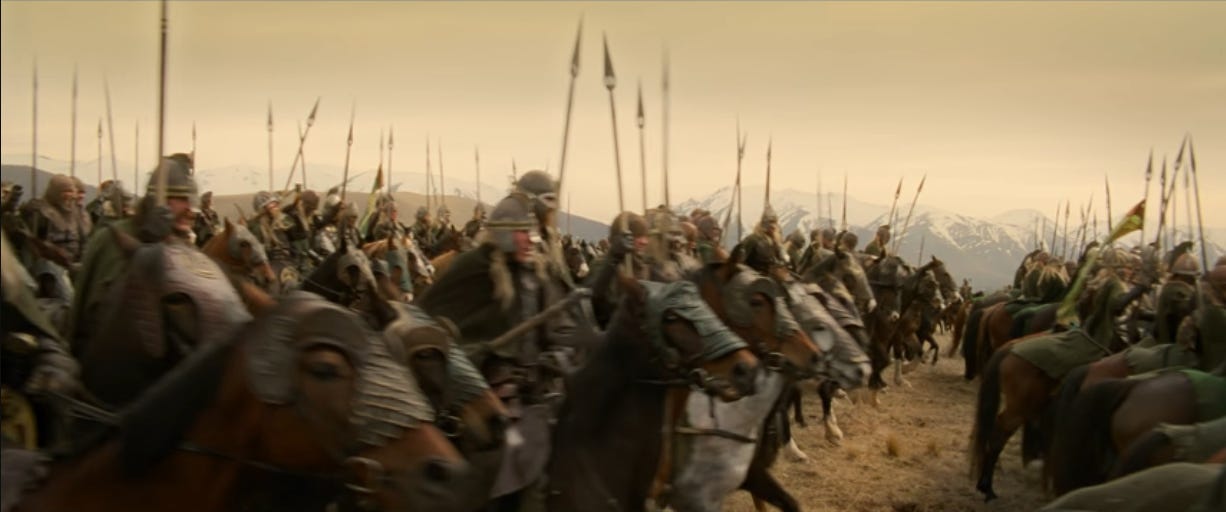
2:32:41: Close-up look at the ranks of horsemen. There’s no sense of urgency, not even a hint of concern. From their body language they could be riding in a parade instead of facing an army many times their size.
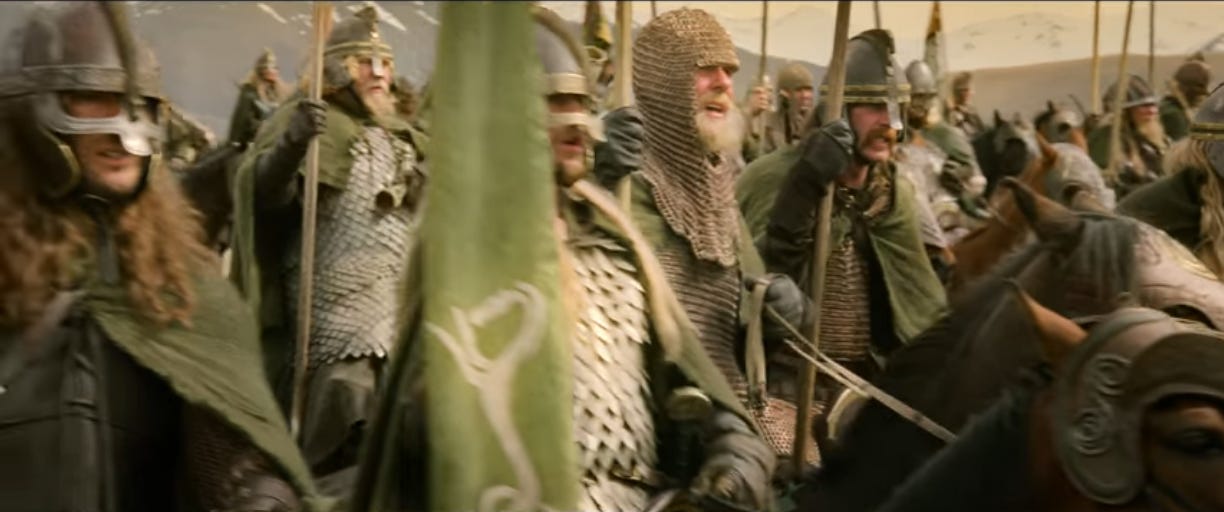
2:32:45: Zoom in. Close enough to distinguish differences. To individualize the mass.
Let’s graft some personalities onto these five guys, from left to right:
- Young dude in his first fight. His helmet is too big and his cloak covers his torso, as though he’s trying to hide.
- The Donut That Rides. His armor looks fancier than the two right-most guys, and he has a horn around his neck. A seasoned vet called out of retirement, was very lucky his armor still fit.
- Professional soldier. Wearing the nice armor and carrying a standard. Voted most likely to survive.
- The old man. No helmet, just a chainmail cowl to go with his chainmail shirt. Squinting because of the cataracts. Definitely going to die, hopefully not from falling off his horse.
- Regretting his life choices guy. Note how he leans on his spear, the way his helmet hangs forward. Militia, someone who went on a bender the night before. Just look at that handlebar mustache. He spins vinyl and smokes Marlboro Reds.
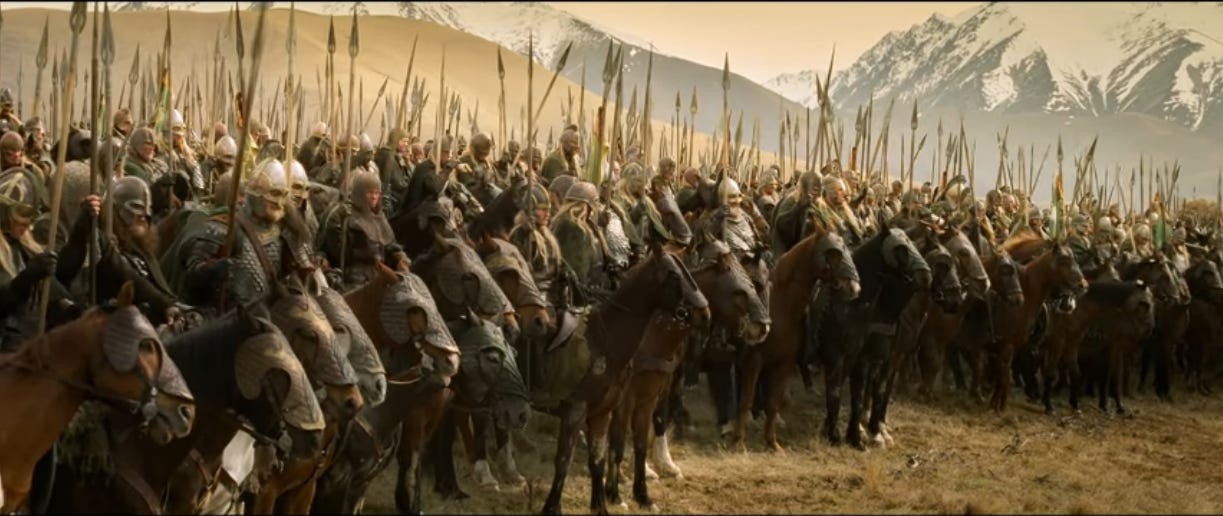
2:32:47: The Rohirrim halt on the ridge.
King Théoden separates from the pack, riding forward for a better look.
Apologies to Potato-face—apparently in Middle-earth, the best way to assess danger is to move a few feet away from your men and stare at some unknown detail.
Just realized that Théoden and Potato-face are unknowingly having a staring contest.
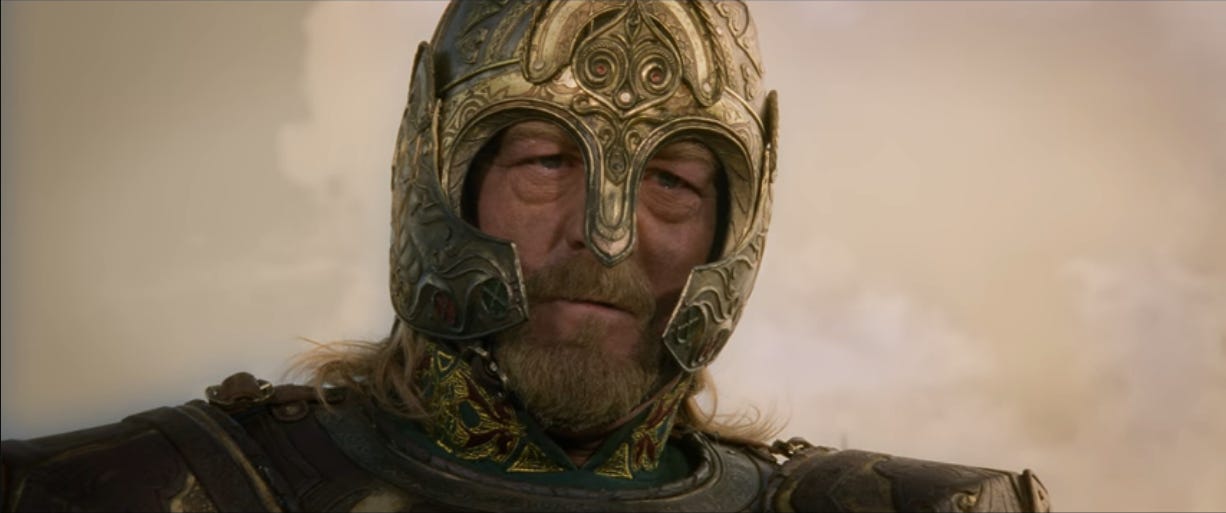
2:32:53: Théoden getting his first look at Minas Tirith.
Shock and horror.
I think he’s also disappointed at how soundly Gondor is getting beaten. Minas Tirith is an impressive fortress. Even against a massive force, they should’ve been able to hold out a little longer, a little better. Alas, Denethor.
Théoden probably imagined fighting alongside Gondor, not risking his forces in a suicidal attempt to lift a siege. Forget the Westfold—where was Gondor when orcs showed up on their own doorstep?
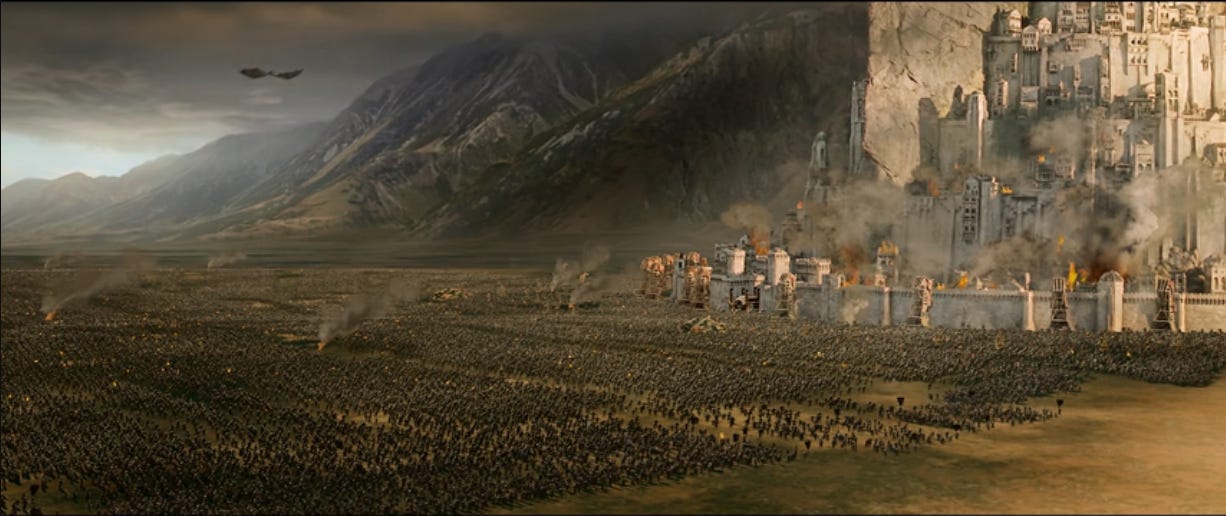
2:32:54: This left-to-right pan takes 4 seconds. The field is filthy with orcs. The film doesn’t give us an exact count, but it’s a helluva lot. We know the Rohirrim number about 6000. They’re outnumbered by magnitudes.
There are long odds, suicidal odds, and we-should-just-go-home odds. This is the latter. Turn the horses around. Game over, man.